
⭐ How to read Europe's Startup Map
🗺️ A guide for angels and investors to understand where to look for different types of startup opportunities across Europe

Hi all, in today’s edition, we’re covering:
🚀 A special analysis and interactive tool of Europe’s startup map, turning Dealroom’s 2026 ecosystem ranking into a practical guide for angels and investors.
💼 Open positions across European startups.
📰 The latest news shaping Europe’s startup ecosystem.
A message from our sponsor:

Startups don’t just need capital, they need investors who share their view of the future. Equidam helps founders translate novel ideas and technologies into valuations that allow both sides to understand the underlying assumptions.
By grounding the fundraising conversation in fundamentals, Equidam helps founders and investors align expectations, build conviction in the company’s trajectory, and address the most important challenges in bits or atoms.
The best startups are outliers, they should be valued accordingly. Get started on your valuation today, with 10% off.
🧭 A New Way To Read Europe
A few weeks ago, we showed how Europe’s strength is not one dominant hub, but instead, a network of very specialised ecosystems, many of them built around universities, research labs and accelerators. Article here!
Now, Dealroom’s 2026 Global Tech Ecosystem Index adds another layer to that story. The report maps the world’s top tech ecosystems through three lenses: scale, density and momentum. Most investors already know which European cities rank highest overall. What is more useful is knowing which cities stand out depending on the type of opportunity they are looking for.
Scale and capital? That is one map.
Technical talent and density? Another one.
Dynamic and under-the-radar hubs? A different one entirely.
So today, we are turning Dealroom’s ranking into a practical guide for angels and investors looking at Europe.
🗺️ Explore The Interactive Map
Before diving into the breakdown, we built an interactive version of Europe’s Startup Map!
You can click on each hub to see its category, strongest sectors and success stories, from London and Paris to Tallinn, Kyiv, Zagreb, Barcelona and Vilnius.
👉 Explore the interactive map here: https://europe-startup-map.netlify.app/

🔎 Dealroom’s Three Lenses
According to Dealroom, startup hubs can be understood through three different lenses.
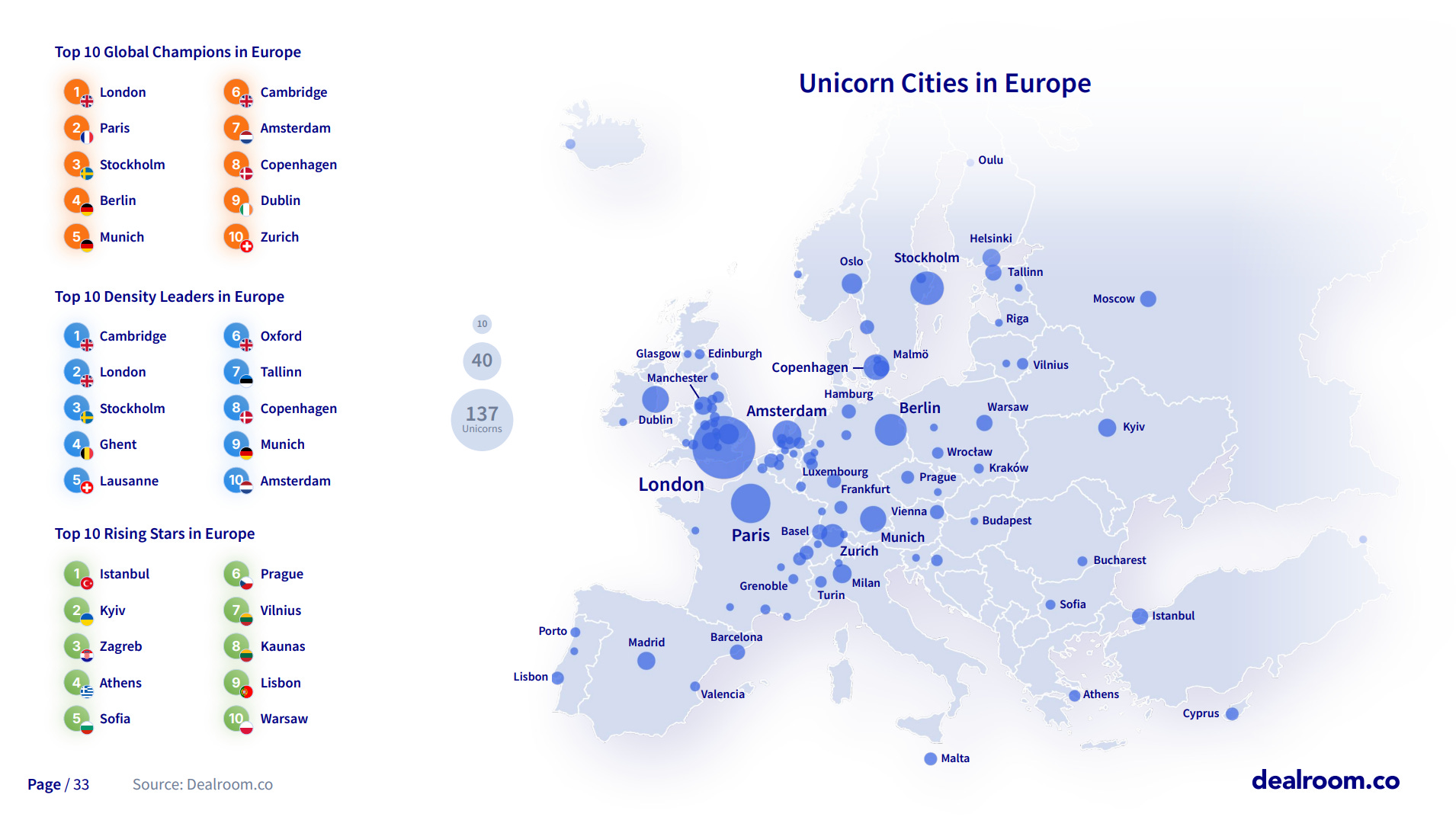
1. Global Champions: the largest and most established ecosystems, measured by venture capital, enterprise value, unicorn creation and university links. Europe has 3 hubs in the global top 20:
London: Europe’s scale machine. Strongest in fintech, AI and enterprise software (Revolut, Wise, ElevenLabs…)
Paris: Europe’s AI and deep tech powerhouse (Mistral AI, Doctolib, Qonto…)
Stockholm: Especially strong in fintech, consumer tech and climate (Klarna, Spotify, Northvolt…)
2. Density Leaders: ecosystems that punch above their weight, producing unusually high startup output relative to their size. Europe has 10 hubs in the global top 20:
Cambridge and Oxford. Science, AI, biotech and university spinouts (two of the world’s strongest research universities).
Lausanne. Deep tech hub, with strengths in robotics, medtech and hard science (largely driven by EPFL).
Ghent. Biotech, healthtech and cleantech. (Ghent University, VIB…)
Tallinn. Fintech, cybersecurity and software.
Copenhagen. Combines fintech, healthtech and climate (Denmark’s strength in life sciences, design and green transition.)
Munich. Industrial deep tech, AI, mobility and defence (Germany’s engineering base).
Amsterdam. Fintech, payments, marketplaces and data (Adyen, Booking.com, bunq…)
London and Stockholm also appear here, proving that they are not only large ecosystems, but also highly productive relative to their size.
3. Rising Stars: the fastest-growing ecosystems, where momentum is building and the next wave may be less obvious. Europe has 3 hubs in the global top 20: Istanbul, Kyiv and Zagreb.
Istanbul. Stands out for gaming, e-commerce and fintech, helped by a large domestic market and companies like Peak Games, Trendyol and Insider.
Kyiv. Combines world-class engineering talent with growing strength in cybersecurity, AI, software and defence tech, represented by companies like Grammarly, MacPaw and newer defence startups.
Zagreb. Smaller, but increasingly interesting in mobility, robotics, SaaS and developer tools, helped by Croatia’s technical talent and success stories like Rimac, Photomath and Infobip.
Together, these three lenses make Europe’s startup map much more useful.
🎯 Where Should Investors Look?
Once you read the map through these three lenses, the question becomes much easier to answer.
Looking for scale and capital? Start with London and Paris.
Looking for AI and deep tech? Watch Paris, Cambridge, Oxford, Lausanne and Munich.
Looking for industrial and applied deep tech? Look at Munich, Berlin and Amsterdam.
Looking for global fintech? Follow London, Stockholm, Amsterdam and Tallinn.
Looking for science spinouts? Focus on Cambridge, Oxford and Lausanne.
Looking for less obvious deals? Watch Tallinn, Ghent, Kyiv, Zagreb, and Istanbul.
Looking for efficient ecosystems? Keep an eye on Cambridge, Ghent, Lausanne, Tallinn and Stockholm.
There is no single best startup hub in Europe.
The best European startup hub depends on what kind of opportunity you are looking for.
👀 Built in Europe Watchlist
Beyond the Dealroom lenses, there are also a few European hubs that may not be the central story of this ranking, but are too relevant to ignore.
Barcelona for healthtech, gaming, B2B SaaS and climate.
Madrid for fintech, mobility, enterprise software and energy.
Helsinki for gaming, quantum, deep tech and health.
Dublin for SaaS, enterprise software and European tech HQs.
Zurich for AI, robotics, biotech, medtech and hard science.
Lisbon for remote-first startups, SaaS, AI and international founders.
Vilnius for fintech, cybersecurity, regtech and Baltic software talent.
💼 Open positions in European Startup
🇬🇧 Semble (software helping clinics manage patient care and admin), who recently raised £30M in a Series C led by Revaia (with Partech, Mercia Ventures, and Octopus Ventures), is hiring across tech, product and sales roles in UK remote, France remote, and Europe remote setups, with office flexibility in London and Paris.
🇫🇷 Innovorder (software helping restaurants manage orders, payments, and operations), who recently raised €20M in a round led by UL Invest (with continued backing from Evolem), is hiring across people, customer care, marketing, engineering, and sales roles in Paris and remote.
🇭🇺 Kodesage (AI software for modernizing legacy enterprise systems), who recently raised $6.6M in a Seed round led by VentureFriends (with Portfolion, Christian Szegedy, and Mario Götze), is hiring across sales, and engineering roles in Budapest.
📰 Inside the European Startup Scene
🇪🇺 The European Commission has launched a new tech sovereignty package to strengthen chips, AI, cloud, and open source, creating fresh demand for Europe’s next generation of digital infrastructure startups.
🏢 Barcelona-based Factorial has raised a $150M Series D at a $2.5B valuation, becoming one of Europe’s most valuable AI scaleups as it expands its workforce operations platform globally.
⚛️ Oxford Quantum Circuits has raised a £260M Series C, Europe’s largest private quantum funding round to date, to scale its quantum computing infrastructure across global markets.
⭐ If you’ve made it this far, thank you!
We’d love to hear your thoughts, so feel free to reply to this email.